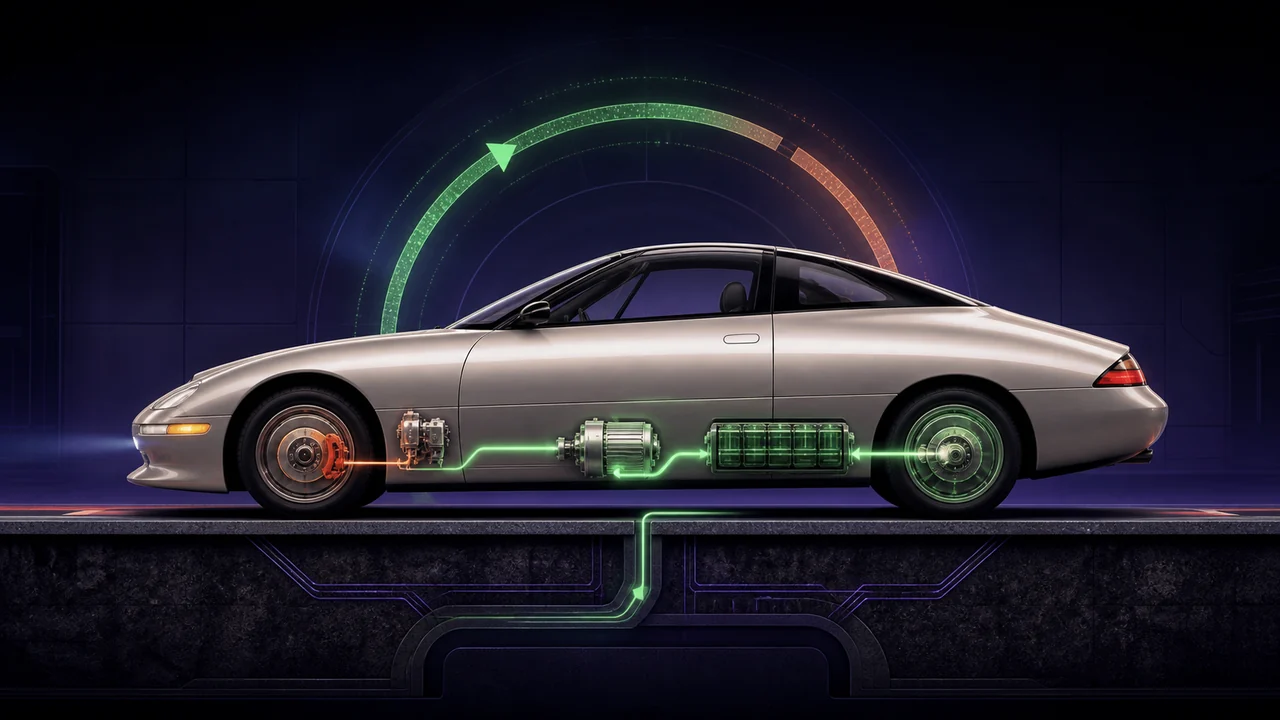
The EV1's importance was not limited to its battery or aerodynamic body. General Motors used the car to integrate conventional friction brakes with regenerative braking through one familiar brake pedal. A Brake Torque Control Module interpreted the driver's request and decided how the two braking systems should work together, while a mechanical backup remained available if the electronic system failed.
From friction-first to regen-first
The original calibration applied friction braking first and then blended in regeneration. For the 1999 model-year EV1, GM says regeneration handled about 90 percent of low-speed deceleration and added roughly 10 miles of range to a car capable of around 90 miles per charge. The later Precept concept reversed the priority: regeneration came first, with friction added when required. GM says that broad strategy continues in its vehicles today.
Why it reaches beyond EVs
The same control idea supports modern one-pedal driving, selectable regenerative force and consistent pedal feel as the battery's ability to accept energy changes. GM also links the EV1 work to its eBoost brake-by-wire system in combustion-powered performance cars, where pedal response can change with the drive mode and coordinate with assistance systems. The legacy is therefore less about one hardware component than about making several braking methods feel like one predictable control.
What regenerative braking recovers
In GM's explanation, the motor acts as a generator during deceleration, returning energy to the battery. Friction braking instead turns motion into heat. The reported 90 percent and roughly 10-mile improvement describe the 1999 EV1 case; they are not a range promise for another EV.
One-pedal driving has limits
GM cautions that its modern one-pedal and Regen on Demand features can be limited when the battery is extremely cold or hot, or nearly fully charged. Its guidance is to use the brake pedal when an immediate stop is needed and consult the owner's manual.
Check the vehicle you actually drive
- Match the model year, market and exact configuration before using a specification or service guide.
- Read that vehicle's manual for regenerative-braking controls and limitations. GM's historical account does not establish how another manufacturer's system behaves.
- Check the applicable maintenance guidance separately. This braking history is not a fluid specification or a replacement schedule.
For a separate US-market example, see the 2024 Tesla Model Y Performance AWD vehicle record and its brake-fluid health guide. Check the cited sources and their applicability to your own vehicle; these Tesla pages do not describe the EV1 or establish fitment for another configuration.